As I said recently, I think of expiration dates as general guidelines for when I should use food, and then, how I should prepare it. My husband, on the other hand, is more likely to follow those dates.
On Monday, I linked to an article from Slate.com about how, well, I was right, and that food is generally safe for consumption past those little stamped dates. I also emailed it to my husband. He responded with this article about using expired foods to save money may not be worth the cost of gastronomical distress.
I thought that I should share it with you, as well. You know, present the other side of the argument and all. It's true, though. I wouldn't want to risk my health to save a few bucks, because in the long run, illness would end up costing more.
I do want to highlight a small portion of the article he sent me:
Sniff tests, as well as checking for any color changes, are usually good indicators of a food's safeness.
Many expiration dates are not symbolic of when the food actually expires, but simply a date that indicates how long before the food's characteristics change. They are also used as a suggestion of "best when used by" dates, or "sell by" dates for grocery stores. -Ashley Holstrom
Felt nice to see that in print. I am a big fan of the sniff test. A caution, though, sniff and sight tests are not fool-proof, and if you are uneasy about eating something, don't.
Here's an interesting site that will tell you how safe something is to consume after the stated expiration date.
Showing posts with label food preservation. Show all posts
Showing posts with label food preservation. Show all posts
Thursday, February 25, 2010


Wednesday, February 24, 2010
Spring is in the... somewhere
It is, really. I can almost feel it in the air sometimes. I find myself dreaming of garden plots that I've never had, on land I don't have either.
Gardening is one of those skills that I could have learned from my mom, had I been paying attention as a kid, instead of running around, climbing trees, sneaking TV, and reading. Certainly those are not bad childhood pursuits, but they left little time for learning of more practical fun skills, like jamming, knitting, or gardening.
I look forward to one day having some semblance of a garden, and harvesting things like tomatoes, cucumbers, and maybe even strawberries from it. I think about what I could use this bounty for, and learning how to can and even pickle to preserve the extra.
I am probably a good ways away from all of that though. I don't have a garden, or even a potted plant. I also don't know how to pressure can, or have a pressure cooker. I've got one heck of a learning curve ahead of me, and I'm sure that it will be full of hard work, mistakes, and inadvertently murdered plants.
I've heard that tomatoes are hardy plants, that seem to grow, despite gardener neglect, so am thinking of starting with these. As well as some herbs that are supposed to do well in pots.
And then there are things like this that seem like they were designed for people like me. People who want to grow things, but have neither the skill, experience, or space to do so. (Yes, I had a shopping channel on as background noise as I was reading one night. I must say, this product intrigued me, but I did not buy one.)
Do you have a backyard, deck, or community garden plot? How long have you been at it? And, any tips for a (very) novice gardener, looking to get started?
Gardening is one of those skills that I could have learned from my mom, had I been paying attention as a kid, instead of running around, climbing trees, sneaking TV, and reading. Certainly those are not bad childhood pursuits, but they left little time for learning of more practical fun skills, like jamming, knitting, or gardening.
I look forward to one day having some semblance of a garden, and harvesting things like tomatoes, cucumbers, and maybe even strawberries from it. I think about what I could use this bounty for, and learning how to can and even pickle to preserve the extra.
I am probably a good ways away from all of that though. I don't have a garden, or even a potted plant. I also don't know how to pressure can, or have a pressure cooker. I've got one heck of a learning curve ahead of me, and I'm sure that it will be full of hard work, mistakes, and inadvertently murdered plants.
I've heard that tomatoes are hardy plants, that seem to grow, despite gardener neglect, so am thinking of starting with these. As well as some herbs that are supposed to do well in pots.
And then there are things like this that seem like they were designed for people like me. People who want to grow things, but have neither the skill, experience, or space to do so. (Yes, I had a shopping channel on as background noise as I was reading one night. I must say, this product intrigued me, but I did not buy one.)
Do you have a backyard, deck, or community garden plot? How long have you been at it? And, any tips for a (very) novice gardener, looking to get started?
Wednesday, February 10, 2010
Taking Stock, part deux
I hope you enjoy the titles of my posts as much as I do. They are chosen because they make me smirk; really hope you get a smile or two out of this blog.
On to the chicken carcass that was chillin' in my fridge on Saturday.
There are actual stock recipes. If you google stock, or check out your favorite how-to cookbook (mine being my old Joy of Cooking), you are bound to find several. They usually call for vegetable scraps or fresh veggies or a bouquet garni of some sort to help flavor the stock. They'll call for a specific amount of bone/carcass to water/veggies. The first time I attempted stock, I found this very helpful. But here's the thing, people have been drawing nutrients for stock for a long time, and did so without recipes.
Basically, what I've taken from the recipes is :
- older chickens tend to have more flavor
- the carcass needs to be completely covered (with usually an inch or so to spare) with water
- veggies can be used to flavor
- you do need to bring it to a boil
- you need to simmer for at least an hour or two
- lid should be set on the pot, slightly ajar, for majority of simmering time
- and skimming the scum is very helpful.
What this means is that my process for stock making is generally:
- place carcass in stock and cover with water
- set to boil
- let boil for a while, check on it
- reduce heat to simmer
- set lid on pot, slightly ajar
- check on it
- go away, read a book, watch some tv
- check on it
- skim the stock
- repeat
When the liquid has reduced (and if I don't feel like adding more), and has gained a color resembling stock, I remove it from the stove. Then, I take out the bones (and anything that was added, like onion or bouquet garni), and divide the stock amongst my storage containers. Washed pasta sauce jars work very nicely. Let it all cool on the counter, and then stick in your fridge. Be sure to rotate any stock still in your fridge to the "top," or where ever you will be able to use it before the new stock.
Because I generally don't add veggies to my stock as it simmers (because I don't often have them on hand), in all honesty, my stock is rather bland. I can see the fat in it, though, and it is more flavorful than plain water.
In case you are curious at all, here are some photos of my freezer:
1. See the tower of stock containers, a bag of frozen veggies, and to the right, the larger containers of soup
2. The plastic bag is wrapped around an old pasta sauce jar of new stock, as a precaution, in reality, this is sitting in front of the tower of stock. The lime sherbert container is actually soup. You can also see my ice trays and DIY ice bucket.
Making your own stock is a relatively easy process that requires very little attention on your part, once the pot is simmering. Have you made your own stock before? Do you do it on a regular basis? If so, do you follow a recipe or add flavoring to it? If not, feel like giving it a go?
On to the chicken carcass that was chillin' in my fridge on Saturday.
There are actual stock recipes. If you google stock, or check out your favorite how-to cookbook (mine being my old Joy of Cooking), you are bound to find several. They usually call for vegetable scraps or fresh veggies or a bouquet garni of some sort to help flavor the stock. They'll call for a specific amount of bone/carcass to water/veggies. The first time I attempted stock, I found this very helpful. But here's the thing, people have been drawing nutrients for stock for a long time, and did so without recipes.
Basically, what I've taken from the recipes is :
- older chickens tend to have more flavor
- the carcass needs to be completely covered (with usually an inch or so to spare) with water
- veggies can be used to flavor
- you do need to bring it to a boil
- you need to simmer for at least an hour or two
- lid should be set on the pot, slightly ajar, for majority of simmering time
- and skimming the scum is very helpful.
What this means is that my process for stock making is generally:
- place carcass in stock and cover with water
- set to boil
- let boil for a while, check on it
- reduce heat to simmer
- set lid on pot, slightly ajar
- check on it
- go away, read a book, watch some tv
- check on it
- skim the stock
- repeat
When the liquid has reduced (and if I don't feel like adding more), and has gained a color resembling stock, I remove it from the stove. Then, I take out the bones (and anything that was added, like onion or bouquet garni), and divide the stock amongst my storage containers. Washed pasta sauce jars work very nicely. Let it all cool on the counter, and then stick in your fridge. Be sure to rotate any stock still in your fridge to the "top," or where ever you will be able to use it before the new stock.
Because I generally don't add veggies to my stock as it simmers (because I don't often have them on hand), in all honesty, my stock is rather bland. I can see the fat in it, though, and it is more flavorful than plain water.
In case you are curious at all, here are some photos of my freezer:
1. See the tower of stock containers, a bag of frozen veggies, and to the right, the larger containers of soup
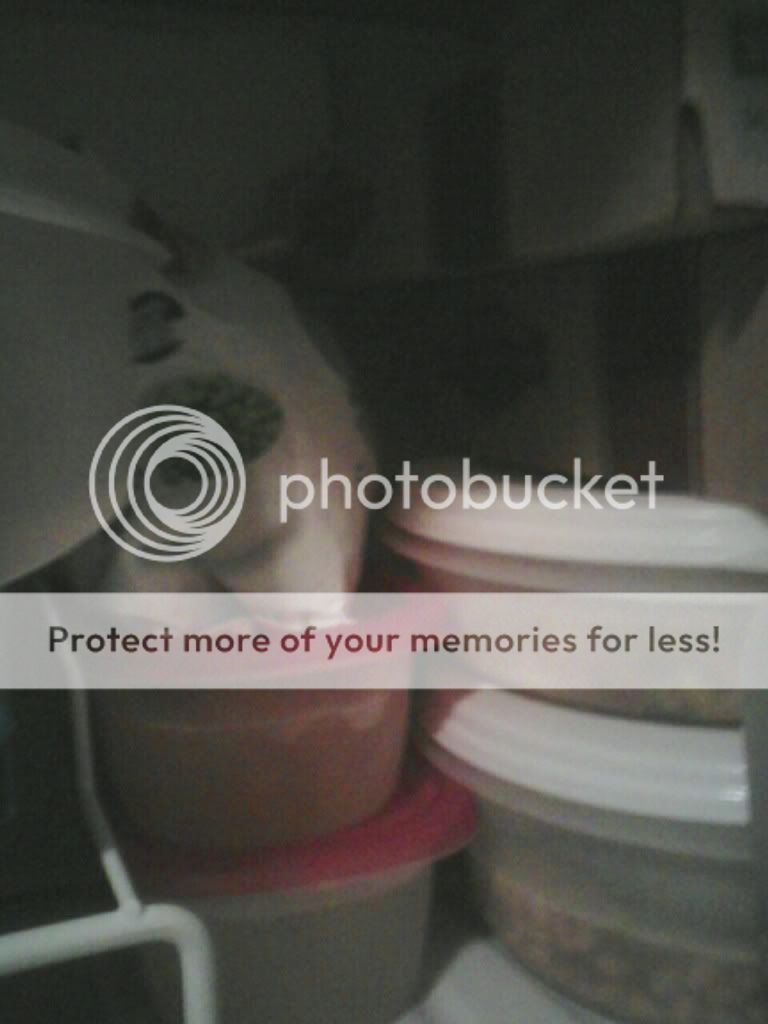
2. The plastic bag is wrapped around an old pasta sauce jar of new stock, as a precaution, in reality, this is sitting in front of the tower of stock. The lime sherbert container is actually soup. You can also see my ice trays and DIY ice bucket.
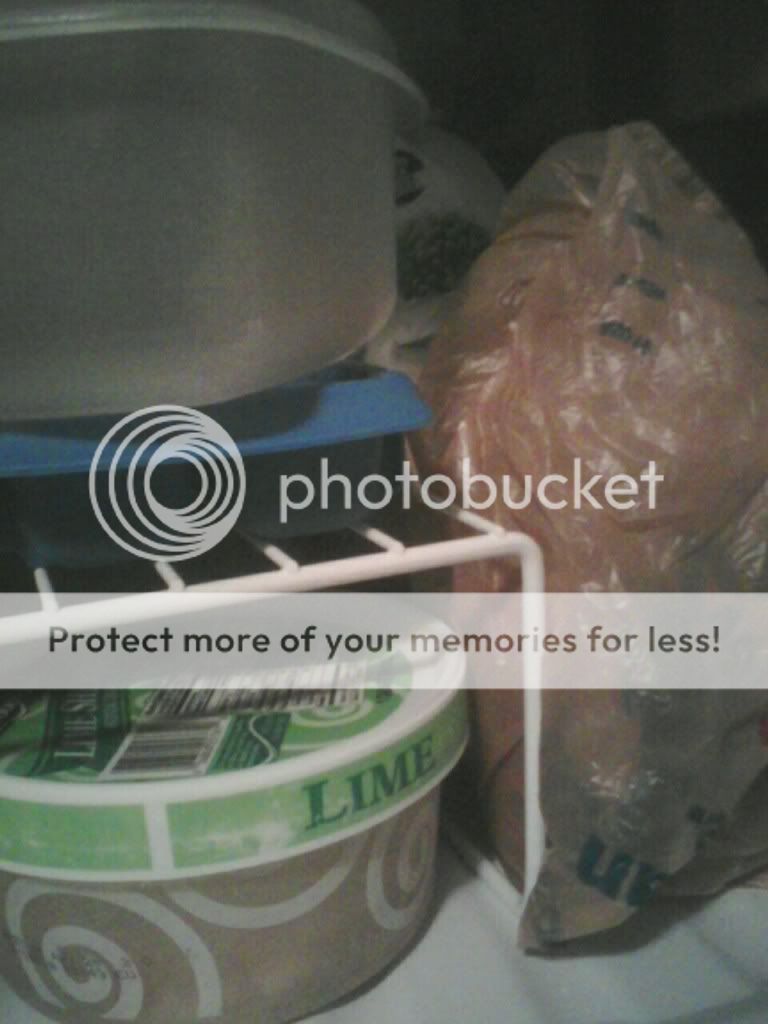
Making your own stock is a relatively easy process that requires very little attention on your part, once the pot is simmering. Have you made your own stock before? Do you do it on a regular basis? If so, do you follow a recipe or add flavoring to it? If not, feel like giving it a go?
Tuesday, February 9, 2010
Taking stock (and giblets, necks, and carcasses)
So that chicken whose giblets I decided I didn't like, what did I do with it?
Here's the run down. Bought the whole chicken on Friday, and baked it that night. (350 degrees Fahrenheit, for 20 minutes a pound, uncovered, on a wire rack in a shallow baking pan. Or until a meat thermometer stuck in the thigh reads 180.)
**Here's an aside about the chicken. I could have bought one of those pre-roasted chickens from the store, and saved myself some time, while still having a bunch of meat and the carcass to use. Why didn't I? Because those are about 2 pound birds, and I paid 56 cents less for a bird that was roughly 4.7 pound. Plus, I got the giblets and neck in addition to the meat and carcass. The pre-roasted chickens aren't a bad deal overall, but if you have the time to spare, cooking a whole chicken yourself is usually more cost-effective.**
As the chicken was in the oven, that is when I started the failed giblet recipe and also set the neck to boiling.
Did you just do a double take? Yeah, well, I took my medium sized sauce pan, filled about half way with water, plunked the neck into it, plus the last quarter of an onion I had laying around. Brought it all to a boil, then reduced to a simmer, and let it alone. I did poke my head over every so often to skim off the scum/fat/foam that forms. I don't remember how long I ended up letting it simmer, but it was probably at least 1.5 to 2 hours. At this point, I discarded the onion and neck, and poured the liquid into a jar.
Yes, a jar. I am running out of inherited and re-purposed plastic storage containers (they are all in my freezer!). I've used the jars to make freezer jam, so they hold up in the freezer, and contain a known quantity (now, if only I could remember what that was). You can see the jar of neck stock here, sort of, along with a beef chuck roast that my aunt gave us, some nuts, and other random stuff on my freezer door.
After the chicken cooled, I carved it up, as best I could. This is not a skill at which I excel. I tried to slice the breasts thin enough for sandwiches, and disjointed the legs and wings. I was quite pleased with the result, because the chicken was tender, sliding right off of the thigh bone. Aside from the bone-in wings and legs, and the sliced breast, everything else was just sort of peeled and pulled off, and stored together.
I put the carcass in my big soup pot, covered it, and stuck it in the fridge. This was all done Friday after I got home from work, mind you. It was getting late, and I wanted to read, spend time with my husband, and oh yeah, sleep! The carcass would keep for a day.
So will the actual stock-taking.
Here's the run down. Bought the whole chicken on Friday, and baked it that night. (350 degrees Fahrenheit, for 20 minutes a pound, uncovered, on a wire rack in a shallow baking pan. Or until a meat thermometer stuck in the thigh reads 180.)
**Here's an aside about the chicken. I could have bought one of those pre-roasted chickens from the store, and saved myself some time, while still having a bunch of meat and the carcass to use. Why didn't I? Because those are about 2 pound birds, and I paid 56 cents less for a bird that was roughly 4.7 pound. Plus, I got the giblets and neck in addition to the meat and carcass. The pre-roasted chickens aren't a bad deal overall, but if you have the time to spare, cooking a whole chicken yourself is usually more cost-effective.**
As the chicken was in the oven, that is when I started the failed giblet recipe and also set the neck to boiling.
Did you just do a double take? Yeah, well, I took my medium sized sauce pan, filled about half way with water, plunked the neck into it, plus the last quarter of an onion I had laying around. Brought it all to a boil, then reduced to a simmer, and let it alone. I did poke my head over every so often to skim off the scum/fat/foam that forms. I don't remember how long I ended up letting it simmer, but it was probably at least 1.5 to 2 hours. At this point, I discarded the onion and neck, and poured the liquid into a jar.
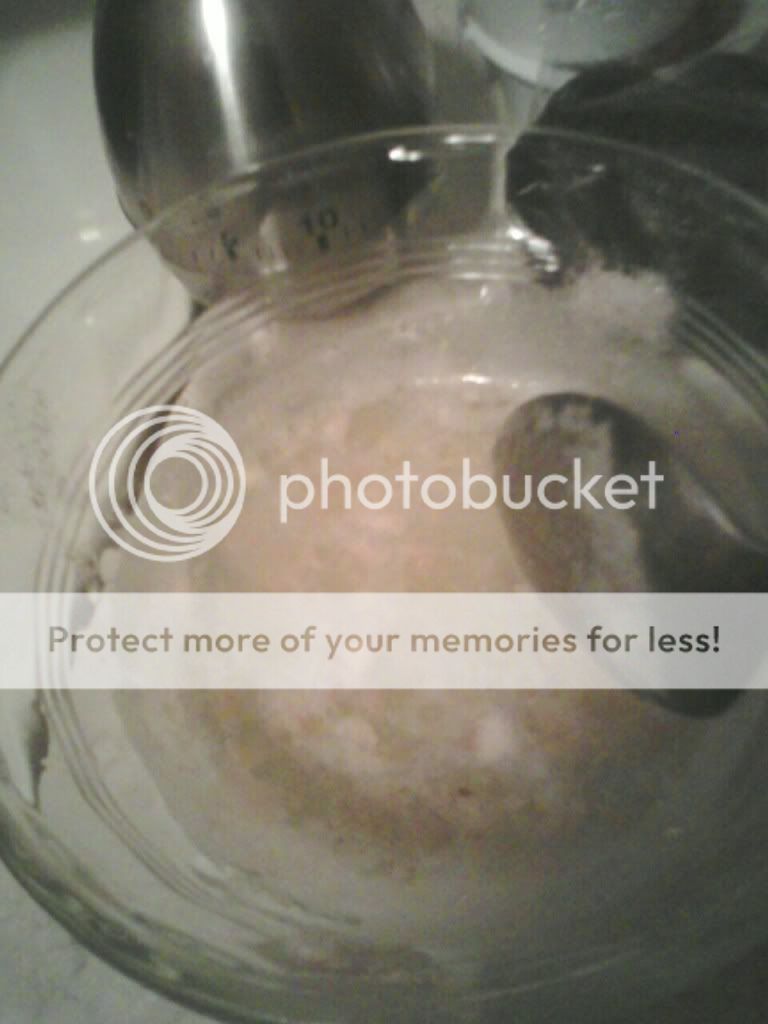
Yes, a jar. I am running out of inherited and re-purposed plastic storage containers (they are all in my freezer!). I've used the jars to make freezer jam, so they hold up in the freezer, and contain a known quantity (now, if only I could remember what that was). You can see the jar of neck stock here, sort of, along with a beef chuck roast that my aunt gave us, some nuts, and other random stuff on my freezer door.

After the chicken cooled, I carved it up, as best I could. This is not a skill at which I excel. I tried to slice the breasts thin enough for sandwiches, and disjointed the legs and wings. I was quite pleased with the result, because the chicken was tender, sliding right off of the thigh bone. Aside from the bone-in wings and legs, and the sliced breast, everything else was just sort of peeled and pulled off, and stored together.
I put the carcass in my big soup pot, covered it, and stuck it in the fridge. This was all done Friday after I got home from work, mind you. It was getting late, and I wanted to read, spend time with my husband, and oh yeah, sleep! The carcass would keep for a day.
So will the actual stock-taking.
Saturday, January 30, 2010
Jams and Jellies and Marmalade, Oh My!
For most of my [relatively short] life, I've bandied about terms like jam and jelly without discretion. But, thanks to a very informative program on a local access channel [go university town cable!], I have now learned that there are definite differences to these products. And, since I fully plan on tackling various preservation methods, I thought it would be handy to define them!
A few notes to start:
- Things like pectin or a gelling agent of some kind (in more modern methods), and heat-canning tend to be common threads between the actual production of these foods. The differences come into play based on what is actually in the jar.
- As I understand it, the term "preserves" is an over-arching term that includes products like jelly, jam, and conserves.
And now, for the differences:
Jelly - is made from fruit (or vegetable) juice.
Jam - contains crushed or cut up pieces of the fruit (or vegetable), as well as juice.
Marmalade - includes bits of the fruit peel, and is generally used only in reference to preserves made from citrus fruits
Conserves - are whole fruits, stewed in sugar. They can also contain things like nuts.
For a quick breakdown of the different kind of fruit and vegetable preserves, you can always check out the Wikipedia article. If I ever stumble across that local access show again, I will be sure to note the names of the people involved.
Poking around a bit online, I did find this USDA site that seems to be chock full of information (so much so, you may not need me, my Joy of Cooking, relatives, or experiments!).
While this is by no means an exhaustive list of preservation methods for fruits and vegetables, it is a run down of what most people in the US will encounter in their pantry or grocery stores. It may be a while before I actually tackle the heat-canning methods, but for now at least, I know the differences between jelly and jam.
Have you ever canned anything, or have memories of a family member doing it? Care to share?
A few notes to start:
- Things like pectin or a gelling agent of some kind (in more modern methods), and heat-canning tend to be common threads between the actual production of these foods. The differences come into play based on what is actually in the jar.
- As I understand it, the term "preserves" is an over-arching term that includes products like jelly, jam, and conserves.
And now, for the differences:
Jelly - is made from fruit (or vegetable) juice.
Jam - contains crushed or cut up pieces of the fruit (or vegetable), as well as juice.
Marmalade - includes bits of the fruit peel, and is generally used only in reference to preserves made from citrus fruits
Conserves - are whole fruits, stewed in sugar. They can also contain things like nuts.
For a quick breakdown of the different kind of fruit and vegetable preserves, you can always check out the Wikipedia article. If I ever stumble across that local access show again, I will be sure to note the names of the people involved.
Poking around a bit online, I did find this USDA site that seems to be chock full of information (so much so, you may not need me, my Joy of Cooking, relatives, or experiments!).
While this is by no means an exhaustive list of preservation methods for fruits and vegetables, it is a run down of what most people in the US will encounter in their pantry or grocery stores. It may be a while before I actually tackle the heat-canning methods, but for now at least, I know the differences between jelly and jam.
Have you ever canned anything, or have memories of a family member doing it? Care to share?
Subscribe to:
Posts (Atom)